Evolutionary Timeline
 |
19 | 1969
Joseph Peitz imports a paver manufacturing machine from Germany to New Jersey to produce 1 million sf (93,000 m2) of “Z” pavers for Roosevelt Island, NY. The machine leaves New Jersey when the project is built. |
 |
1973
KNR Concrete is started by Wolf Mueller in Toronto, later purchased and renamed Unilock. |
|
 |
1982
610,000 sf (56,700 m2) of interlocking concrete pavement opens at the Massey Coal Terminal in Newport News, VA. The pavers are subject to high loads from coal storage piles and abrasive loads from steel-tracked bulldozers. |
|
 |
1983 North Bay, ON, places 150,000 sf (13,900 m2) in downtown streets and sidewalks. This project confirms the ability of concrete pavers to survive harsh winter conditions on municipal streets. |
|
 |
1985
The first mechanically installed, public street of 11,000 sf (1,000 m2) is constructed with interlocking concrete pavement in a historic district. |
|
| 1989
The Concrete Paver Institute (CPI) is formed within NCMA to raise industry identity and provide resources for manufacturers, designers and contractors. |
||
 |
1990
The Port of Baltimore, MD, places 230,000 sf (21,300 m2) of pavers in a wharf area that would eventually grow to 2 million sf (185,800 m2) of pavers. |
|
The ASCE Journal of Transportation publishes “Structural Design of Concrete Block Pavements” by Gonzalo Rada, David Smith, John Miller and Dr. Matthew Witczak. This paper demonstrates the application of AASHTO flexible pavement design to interlocking concrete pavements. This approach was initially developed by Dr. Witczak. |
||
| CPI hosts a focus group of prominent U.S. and Canadian pavement engineers (including Dr. Witczak) who propose steps for institutionalizing interlocking concrete pavement. Their report provides the framework for the next several decades: develop design guides; test methods, specifications and maintenance guides; do research and demonstration projects; and promote. | ||
 |
Dr. Brian Shackel, a University of New South Wales, Australia, researcher on interlocking concrete pavements, publishes Design and Construction of Interlocking Concrete Block Pavements through Elsevier (230 pages). The book summarizes his and other’s research from the late 1970s through the 1980s. The book addresses many positive aspects of pavement performance. He later promotes interlocking concrete pavement in North America. | |
 |
San Antonio, TX, places 1 million sf (93,000 m2) of interlocking concrete pavement in streets and sidewalks in its downtown. The pavement is subject to constant bus traffic. | |
| Dallas/Ft. Worth International Airport places 260,000 sf (24,100 m2) of concrete pavers in cross taxiways, saving the airlines over $4 million in delays. | ||
| The first sales school is held for industry product representatives. Over 25 schools are held in the coming years including ones on advanced technical topics. | ||
| 1991
CPI issues CAD drawings of various concrete paver applications on 3.5 in. floppy disks. |
||
| 1992
CPI supports bedding sand research by the Royal Military College of Canada. Results provide test methods and acceptance criteria for bedding sands in high traffic/load applications. |
||
 |
CPI issues its first installation training manual, Building Interlocking Concrete Pavements. The manual becomes the blueprint for an installer certification program developed some years later. | |
| NASA conducts skid resistance tests on interlocking concrete pavements using a B-737 aircraft tire in Langley, VA (25,000-lb wheel load). Skid resistance is similar to grooved concrete runway pavement. Dentated pavers provide additional structural lateral stability under high wheel loads and hard braking. | ||
1993 The Segmental Concrete Systems Association is formed in Chicago, IL, later renamed the Interlocking Concrete Pavement Institute (ICPI). Sixty-six charter manufacturer, supplier and contractor members fund the upstart group. |
||
 |
1994
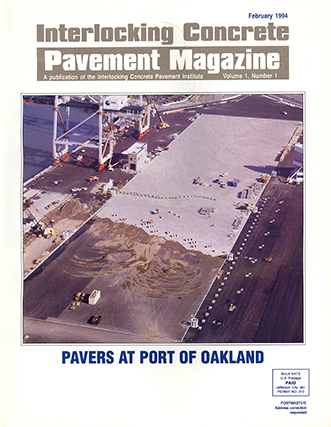
The first issue of Interlocking Concrete Pavement Magazine is mailed to about 7,000 readers and featured 300,000 sf (27,900 m2) in Berth 30 at the Port of Oakland, CA. Interlocking Concrete Pavement Magazine - Vol. 1, Issue 1 Port of Oakland - the largest block paving project in the western hemisphere |
|
| The first ICPI annual meeting is held in Atlanta, GA. | ||
 |
ICPI releases a new logo to convey interlocking. | |
1995 Interlocking Concrete Pavement Magazine first reports on permeable interlocking concrete pavements (PICP). |
||
| 1996
ICPI releases Pavespec software for structural design of interlocking concrete pavements that follows AASHTO flexible pavement design methods. |
||
| ICPI introduces an installer certification program with a comprehensive student manual, course materials and instructor training. Some 15,000 contractors take the course in the coming years. | ||
| 1997
The Pennsylvania Transportation Institute studies skid resistance of interlocking concrete pavements demonstrating characteristics similar to conventional pavements. |
||
| 2000
ICPI releases the first edition of Permeable Interlocking Concrete Pavements – Design Specifications Construction Maintenance. Three more editions are released with the latest fourth edition in 2011. |
||
| The ICPI Foundation for Education & Research is created to advance the technical and educational industry subjects with an endowment goal of $5 million. | ||
 |
2001
Port of Oakland, CA, pavement construction begins on 5 million sf (464,500 m2) of interlocking concrete pavement on new container terminals at Berths 55-59. |
|
2002-2004 ICPI funds research by the University of Pittsburgh and the Veterans Administration to define interaction between different paver types on wheelchair vibration. |
||
| 2003
ICPI rolls out www.icpi.org. |
||
| 2006
ICPI hosts the 8th International Conference on Concrete Block Paving in San Francisco, CA, with over 400 delegates. |
||
| ICPI introduces Permeable Design Pro software for PICP hydrologic and structural design. | ||
| 2007
North Carolina State University completes PICP research that demonstrates positive infiltration performance and pollutant reductions. |
||
| The ICPI Foundation funds development of a website resource for landscape architecture students and professors. The site develops into www.paveshare.org. | ||
| ICPI launches Hardscape North America, a new trade show for the industry. | ||
| 2008
ICPI moves offices to Herndon, VA, and transitions to self-management. Staff increases to eight with an annual budget of $3 million. |
||
2009 ICPI rolls out commercial technician and PICP specialist courses. |
||
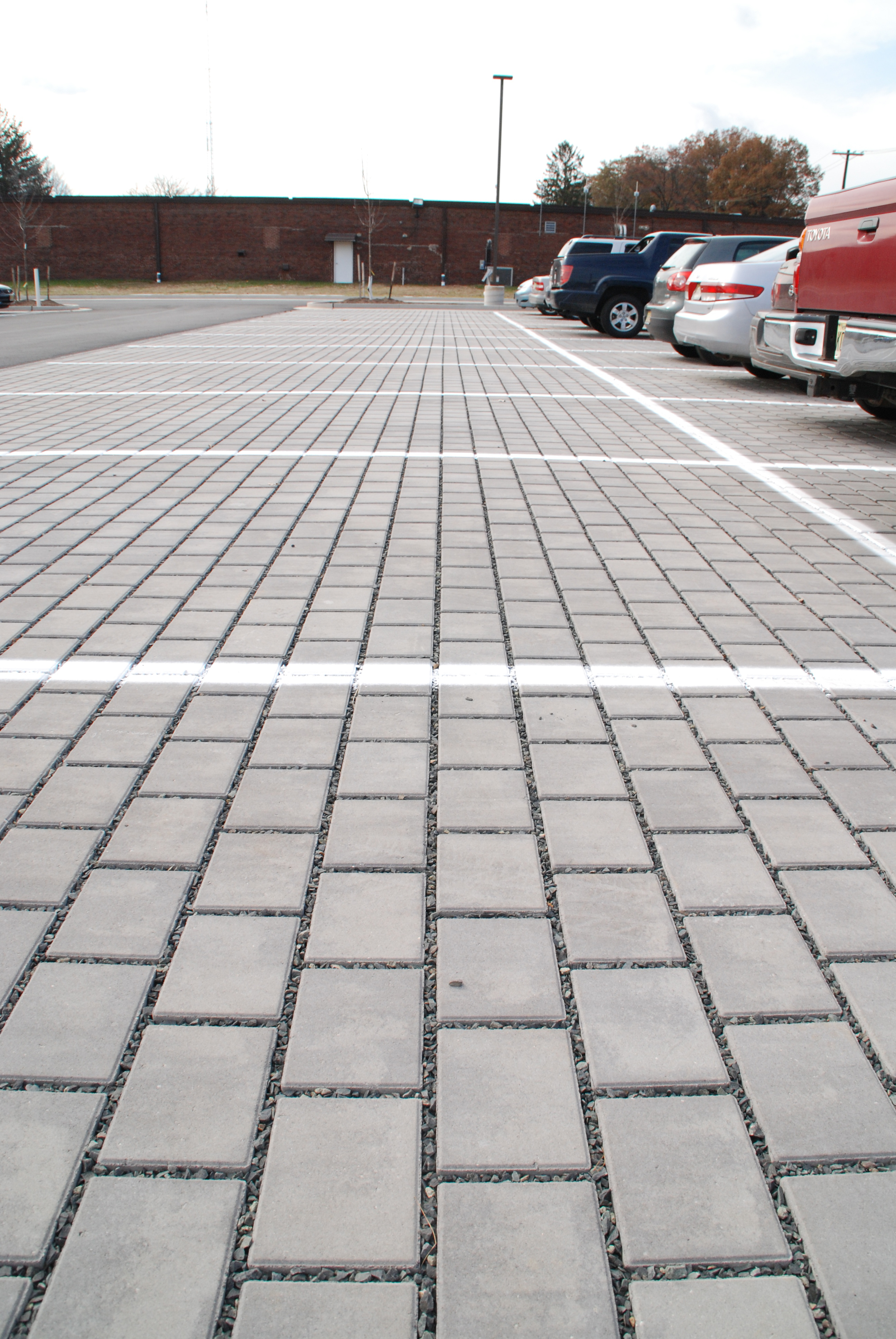 |
The U.S. Environmental Protection Agency completes a permeable pavement parking lot at offices in Edison, NJ. The agency conducts long-term monitoring and maintenance. | |
 |
2010
The ASCE releases standard 58-10 Structural Design of Interlocking Concrete Pavement for Municipal Streets and Roadways. ICPI offers design software that follows this procedure. |
|
| The University of Waterloo completes crosswalk performance research and design guidelines. The University of New Hampshire Stormwater Center monitors PICP for two years on their campus that yields almost 100 percent infiltration of runoff. | ||
| 2012
ICPI rolls out the Advanced Residential Paver Technician course. |
||
| The U.S. Transportation Authorization Act, also known as MAP-21, includes a mandate for technology transfer and research on permeable pavements. | ||
 |
Like Chicago and its suburbs, Iowa towns use PICP for publicly owned streets and alleys as an integral part of infrastructure redevelopment projects. Green alleys are built in dozens of cities thanks to federal, state and local green infrastructure funding to reduce combined sewer overflows. | |
 |
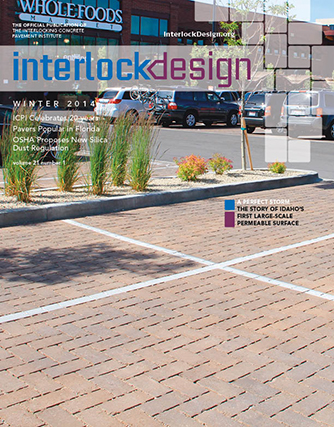
Interlocking Concrete Pavement Magazine is redesigned and renamed Interlock Design. | |
| 2013
The ICPI Foundation funds PICP structural and performance research projects in the U.S. and Canada. |
||
| The industry produces about 500 million sf (46.5 million m2) of pavers, slabs and grids, made by approximately 110 companies in the U.S. and Canada. | ||
| Supported by federal and state transportation departments, the Local Technical Assistance Program (LTAP) Centers for Technology Transfer (T2) receive information on permeable pavements. | ||
 |
ICPI completes its 18th Tech Spec technical bulletin on PICP construction. All 18 bulletins covering design, construction and maintenance topics are on www.icpi.org. | |
| The ICPI Foundation funds the development of product category rules (PCRs) for segmental concrete pavements. | ||
| After a five-year hiatus from the recession, ICPI hosts a school (with NCMA) for commercial sales representatives. The school is attended to capacity, indicating an upturn in this market. | ||
 |
ICPI purchases space for new offices in Chantilly, VA. The new address is 14801 Murdock Street - Suite 230, Chantilly, VA, 20151. Canadian offices continue in Uxbridge, ON. |